The proposed new National Park for North East Wales
(posted October 2023. See below for updates)
Back in the spring of 2021, Mark Drakeford, then First Minister, announced the Welsh Government’s intention to create a new National Park in the north east, to be the 4th National Park in Wales alongside Eryri, Bannau Brycheiniog and Pembrokeshire.
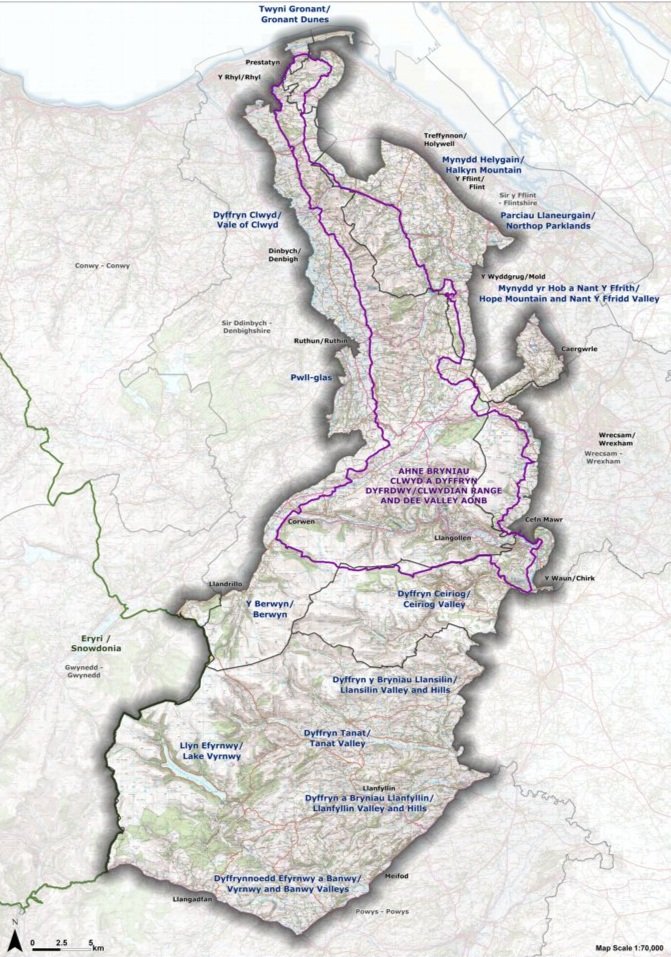
Natural Resources Wales have been tasked with evaluating the case for it, and have recently published their Area of Search map. That’s not necessarily the final boundaries for the Park (and the Park itself isn’t yet a foregone conclusion); it’s the initial area that’s been chosen on the basis of its natural characteristics of habitat and topography, for further consideration that’ll also take into account its use for recreational activities.
To assist with this further work, NRW have now started a series of public engagement events which will run to 27th November 2023, and details of those along with a ‘zoomable’ map of the search area and a copy of the Engagement Leaflet (with an evaluation timeline) are on the NRW’s consultation portal – link below.
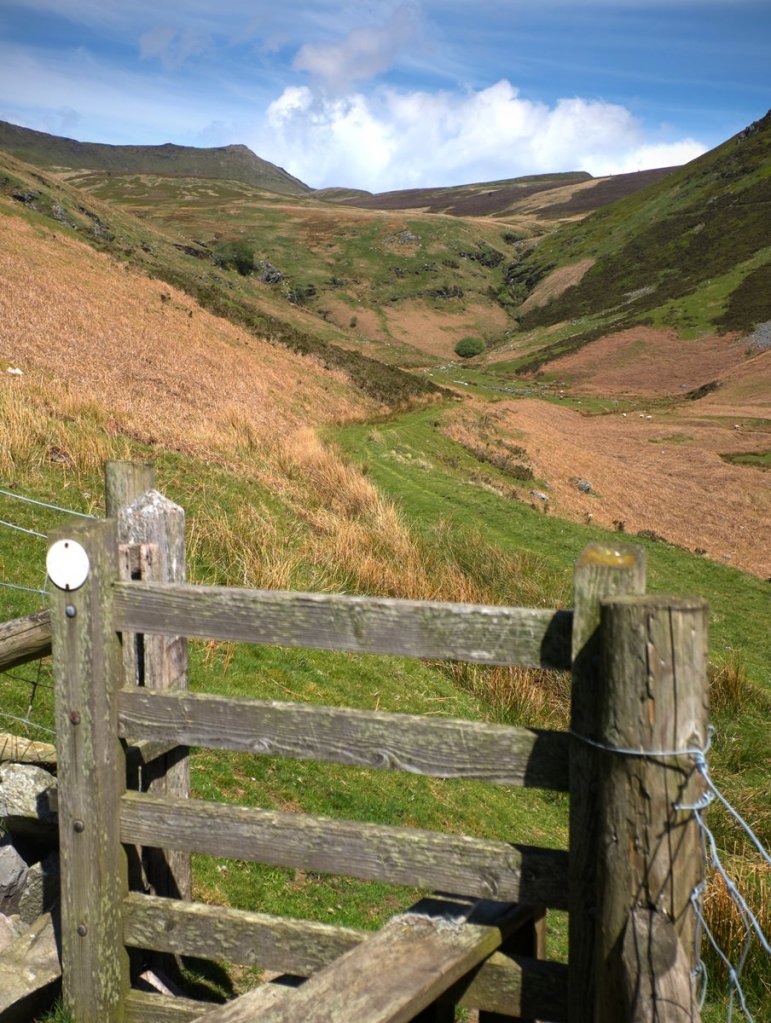
The ‘area of search’ is extensive, covering a much larger area than the current Clwydian Range and Dee Valley Area of Outstanding Natural Beauty (edged purple on the map above). It takes in Halkyn Mountain and Hope Mountain in the north, and extends over the whole of the Berwyn mountains as far as Llangadfan in Powys in the south, and over to Glyn Ceiriog in Wrexham County in the east. So it includes the popular areas of Llyn Efyrnwy (aka Lake Vyrnwy), the waterfall at Pistyll Rhaeadr and the mountains on the Cadair Berwyn/Cadair Bronwen ridge (photo below).
And in the south west it reaches and joins up with Eryri National Park, near the Penllyn Forest, and those more obscure ‘Nuttall’ 2000 foot mountains that are lost in a sea of heather on the skyline between Llyn Tegid and Llyn Efyrnwy.
It doesn’t though (as early media coverage has highlighted) include Denbigh Moors and the Clocaenog Forest. For now that area, and the nearby area around Foel Goch above Llangwm, looks like remaining the only significant areas of upland North Wales that won’t have National Park status and protection.
What would National Park designation mean?
In brief :
- Areas of Outstanding Natural Beauty (and the area outside them) are managed by a partnership of local county councils. National Parks are managed by a special authority of their own. That authority takes over the statutory planning responsibilities, and makes decisions on planning applications itself.
- Both National Parks & AONB’s have obligations to protect the landscape and scenic beauty. National Parks are also legally obliged to provide for public recreational opportunities. AONB’s only have a somewhat secondary responsibility to ‘take account of recreational needs so far as this is consistent with the conservation of natural beauty’.
- National Parks receive much higher funding than AONB’s. Of their core funding (65% of their total income roughly, the rest being grants, and income they raise themselves), 2/3rds comes from the Welsh Government, with the remainder from local authorities. AONB’s core funding comes entirely from local authorities.
Would a new National Park be good or bad?
Entirely a matter of personal opinion!
With biodiversity in crisis, and Wales being one of the most nature-depleted countries on earth, the additional protection has to be welcomed.
Opponents express concerns about potential increases in visitor numbers, and the stress that might place on local hot-spots, and on housing demand and prices. And about planning, and that permission for developments might be more difficult to obtain.
Much of that is down to how a new authority runs things. Some National Parks have gained a good reputation with local residents for their planning decisions; others not so much.
Where areas are under pressure already from demands from visitors, is that because of a National Park designation itself, or is it because they happen to be beautiful areas that people want to go to anyway? Don’t people visit Yr Wyddfa because it’s the highest, and Moel Famau because it’s accessible, rather than because of any labels? Ynys Môn and Llŷn have huge problems with second homes, but are outside the National Park. I can see that the Berwyn (currently one of Wales’ best kept secrets) might attract a bit more attention, but won’t that be heavily mitigated by its lack of accessibility? Personally I’m not convinced that the designation itself makes that much difference to demand.
If there is an impact though, at least the guardians of these special places will be better funded, and therefore better equipped, to manage the demand. There’s a suggestion that funding will be around 10 times greater than currently, and if that’s spent locally, and re-circulates, that’s a major boost for the local rural economy, irrespective of any additional tourism income. And that’s the factor that swings it for me.



October 2024 Update :
The Search Area has now been fully evaluated, and the Evaluation Report published.
To undertake their appraisal, the original Search Area was adjusted, and then broken down into Evaluation Areas, and assessed under the criteria of Natural Beauty, and Opportunities for Open-air Recreation. Each EA is dealt with separately in the report. Some of these have now been excluded (e.g. Halkyn Mountain, Hope Mountain, Mynydd Mynyllod and the Upper Dee Valley), and a new Candidate Area arrived at.
A common reason for rejecting some EAs is that although they offer small areas where the required criteria are met, this tends to be fragmented (and, for example, interspersed with areas with larger scale human influences such as quarries or pylons). As such they couldn’t contribute to the aim of creating ‘a continuous and extensive tract of land’.
NRW are now carrying out a further series of engagement events and seeking views on the Candidate Area. Details are here : https://ymgynghori.cyfoethnaturiol.cymru/north-east-gogledd-ddwyrain/waless-national-park-proposal-public-consultation/
October 2025 Update
Click here : Oct 25 blog post
 moel a mynydd - hill & mountain